
If you’re a Nigerian student preparing to study in the UK, Canada or the USA, housing is probably the part of your plan that keeps changing shape. Tuition is fixed. Flights have a price tag. But accommodation? You’ve likely seen three different numbers for the same city and no clear answer on which one is real.
Purpose-built student accommodation, or PBSA, is one of the options you’ll run into during that search, usually alongside university halls and private rentals. This article breaks down what PBSA actually is, what it costs in 2026 across the UK, Canada and the USA, and when it genuinely saves you money compared to renting privately. You’ll also get a decision framework, real cost tables, and the questions to ask before you sign anything from Lagos or Abuja.
One thing before we start: rent, visa rules and university policies change often. Treat every figure here as a planning estimate and confirm current prices directly with the accommodation provider or your university’s international office before you commit.
What Is Purpose-Built Student Accommodation (PBSA)?
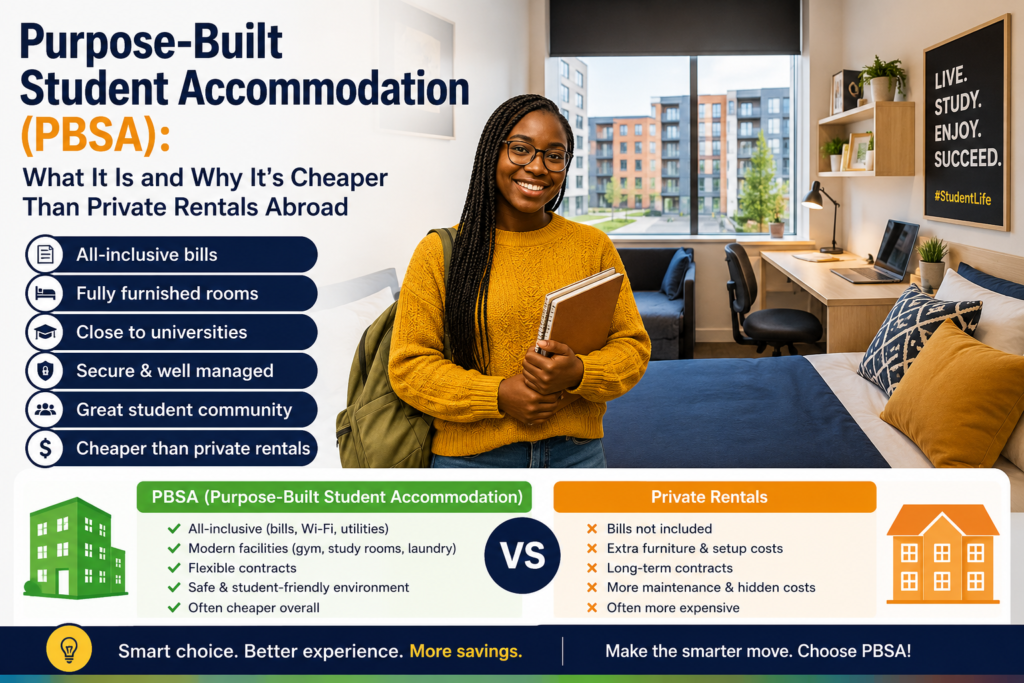
Purpose-built student accommodation (PBSA) is housing that’s designed and constructed specifically for students, rather than adapted from an ordinary house or flat. It’s usually built and run by private companies, not by the university itself, though some schemes operate in partnership with a university. A PBSA building typically includes private or en-suite bedrooms, shared or private kitchens, study rooms, gyms, laundry facilities, and 24-hour security or on-site staff.
That last point is what separates PBSA from a university hall. Halls are owned and run by the university. PBSA is owned and run by private operators such as Yugo, Scape, iQ Student Accommodation, or Unite Students in the UK, or similar operators in Canada and the USA. Both exist to house students, but the ownership, pricing model and contract terms differ.
PBSA also differs from a private rental. A private rental is an ordinary flat or house on the open market that happens to have a student tenant. PBSA is purpose-designed housing where every tenant is a student. One operator manages the Wi-Fi, cleaning, security and maintenance requests for the whole building.
RECOMMENDED POST:
Hybrid Study Abroad Programs in the USA: How Nigerian and African Students Can Cut Costs and Study Part-Online, Part-Overseas
PBSA vs Halls vs Private Rental: The Core Difference
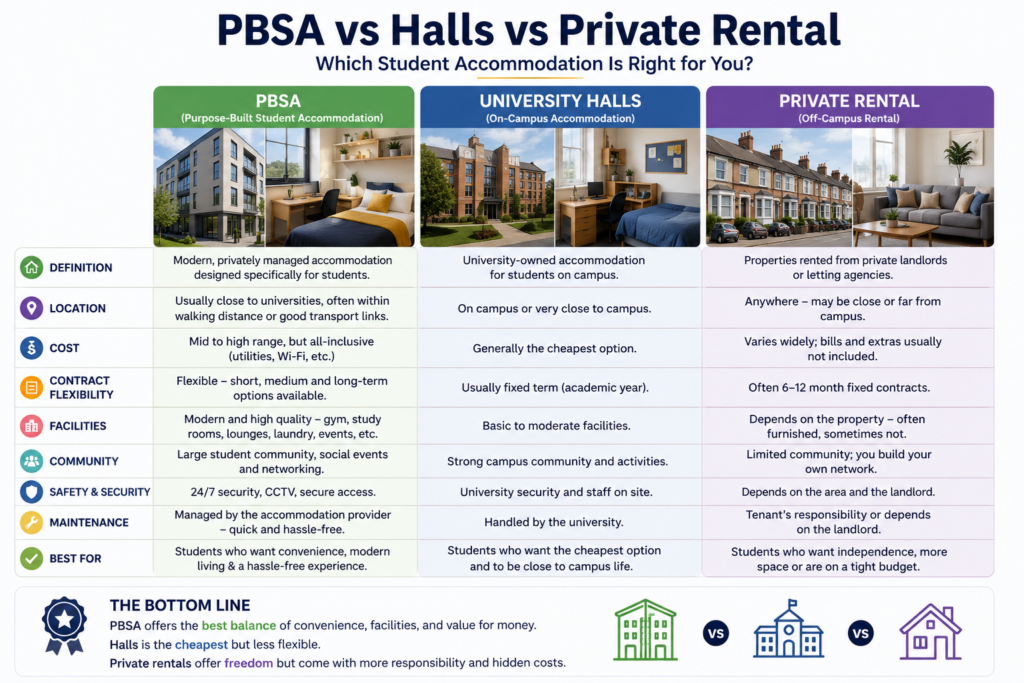
| Feature | University Halls | PBSA | Private Rental |
|---|---|---|---|
| Owned by | University | Private company | Individual landlord or letting agent |
| Built for students | Yes | Yes | No, usually adapted |
| Bills included | Usually | Almost always | Rarely, unless stated |
| Guarantor required | Rarely | Rarely for international students | Almost always |
| Contract length | Academic year (38-44 weeks) | 44-51 weeks, sometimes 12 months | 12 months typical |
| On-site security | Yes | Yes | No |
| Location | On or near campus | Near campus or city centre | Anywhere in the city |
| Price predictability | High | High | Low, separate bills |
How PBSA Works: Room Types, Contracts and What’s Included
Before you compare prices, you need to know what you’re actually buying. PBSA rooms generally fall into three categories.
En-suite rooms give you a private bedroom with your own bathroom, while you share a kitchen and living area with three to six other students in a cluster flat. This is the most common and usually the most affordable PBSA option.
Studio apartments give you a self-contained unit with your own bedroom, bathroom and kitchenette. You don’t share anything. This is the most private and most expensive PBSA option.
Shared rooms are less common in PBSA but exist in some budget-focused buildings, where two students share a bedroom to cut costs further.
Most PBSA contracts run for 44 to 51 weeks, aligned with the academic calendar, though some operators now offer 12-month contracts. Almost all PBSA rent is quoted as an all-inclusive price. That means your rent already covers electricity, heating, water, and high-speed internet. Some buildings bundle in a gym membership or a weekly cleaning service for shared areas.
This is where the “cheaper than it looks” argument for PBSA actually starts. A private rental listing might show a lower base rent, but you’ll add electricity, gas, water, internet and often a TV licence (in the UK) on top. PBSA folds all of that into one number, which makes it far easier to budget accurately from Nigeria, where you can’t walk into the building and check the meter yourself.
PBSA vs Private Rentals: Real Cost Comparison by Country
Here’s where the numbers matter. Prices below are 2026 planning ranges gathered from housing platforms, university guidance and property market reports. They will vary by city, building quality and how far in advance you book. Use them to set a realistic budget range, not as a fixed quote.
United Kingdom (Monthly Rent, GBP)
| Accommodation Type | Outside London | London |
|---|---|---|
| University halls | £650 – £1,700 | £1,300 – £1,800+ |
| PBSA (en-suite) | £700 – £1,200 | £1,100 – £2,000+ |
| PBSA (studio) | £900 – £1,470 | £1,500 – £3,000+ |
| Private rental, shared house | £550 – £850 | £900 – £1,500+ |
| Private rental, solo studio | £900 – £1,400 | £2,000 – £4,000+ |
In most UK cities outside London, sharing a private house with several housemates is genuinely cheaper per month than PBSA. But once you factor in separate utility bills, a UK guarantor requirement that many international students can’t meet, and the deposit protection process, the gap narrows. PBSA providers in an approved code are typically exempt from the new advance-rent restrictions that apply to private landlords under the UK’s Renters’ Rights Act, which took effect from May 2026, and can still accept a full year’s rent upfront. That matters if you’re financing your stay with a lump sum from home rather than a UK bank account.
Canada (Monthly Rent, CAD)
| Accommodation Type | Toronto | Montreal | Smaller Cities (e.g. Halifax) |
|---|---|---|---|
| On-campus residence | $950 – $1,800 | $700 – $1,200 | $600 – $1,000 |
| PBSA / private student residence | $1,200 – $2,000 | $800 – $1,400 | $700 – $1,200 |
| Private rental, shared apartment | $700 – $1,200 | $500 – $900 | $400 – $700 |
| Private rental, solo studio | $1,500 – $2,500+ | $1,000 – $1,600 | $800 – $1,300 |
Canada’s PBSA sector is younger and smaller than the UK’s, and it’s genuinely undersupplied in cities like Toronto and Vancouver. That undersupply keeps PBSA prices close to, or sometimes above, private studio rentals in the same neighbourhood. The clearest advantage for a Nigerian student isn’t always price. It’s that most PBSA operators and on-campus residences don’t require a Canadian guarantor, which private landlords almost always do. If you’re arriving without a Canadian co-signer, that alone can make PBSA the only realistic option in your first year, regardless of the exact monthly saving.
United States (Monthly Rent, USD)
| Accommodation Type | National Average | High-Cost Cities (NYC, LA, Boston) |
|---|---|---|
| On-campus dorm, double room | $800 – $1,400 | $1,200 – $1,800 |
| PBSA (private student housing) | $900 – $1,800 | $1,500 – $2,500+ |
| Private rental, shared apartment | $700 – $1,500 | $1,200 – $2,200+ |
| Private rental, solo apartment | $1,200 – $2,200 | $2,000 – $3,500+ |
In the USA, the national average PBSA rent sits close to $900 to $950 per bed per month, based on recent market data, which places it in the same range as a shared off-campus apartment once you add utilities to the apartment’s base rent. The real separator in the US market is credit history. Most private landlords run a credit check and ask for a US-based guarantor or several months of rent paid upfront. PBSA operators that specialize in international and student tenants are far more likely to accept an international student without US credit history, sometimes in exchange for a larger security deposit instead.
Why PBSA Often Works Out Cheaper Once You Add the Hidden Costs of Private Renting
The headline rent on a private rental listing rarely tells the full story. Here’s what typically gets added on:
Separate utility bills. Electricity, gas, water and internet can add £100-£200 a month in the UK, CAD $150-$250 in Canada, and $150-$300 in the USA, depending on the season and how efficiently the property is insulated. Winter heating in Canada and parts of the northern USA pushes this figure higher between November and March.
Guarantor requirements. Most private landlords in the UK, Canada and the USA want a local guarantor who earns a certain multiple of the annual rent, or they’ll ask for six to twelve months of rent paid upfront instead. If you don’t have a relative or contact who qualifies as a guarantor in your destination country, this single requirement can rule out private renting entirely in your first year.
Furniture and setup costs. Private rentals are frequently unfurnished or partly furnished. Budget furniture packages in the USA run $100-$300 a month to rent, or several hundred dollars to buy secondhand. PBSA rooms come fully furnished, which matters if you’re arriving with two suitcases and no local network to help you shop.
Deposit and agency fees. Private lettings typically require a deposit worth four to five weeks’ rent, held in a government-approved scheme in the UK, plus sometimes a letting agency fee. PBSA deposits tend to be smaller and are collected directly by the operator.
Scam risk. International students renting sight-unseen are a frequent target for rental fraud, particularly on informal listing sites and Facebook groups. Losing a deposit to a fake listing before you’ve even landed is a real financial risk that PBSA, booked through a verified operator or platform, largely removes.
When you add these costs together, a private rental that looked £150 or $150 cheaper on paper can end up costing about the same as PBSA, or more, once your first month’s bills, deposit and furniture arrive. The PBSA price is simply more honest upfront.

When Private Rentals Are Actually Cheaper
To be fair to private renting, it does win in specific situations, and it’s worth knowing when.
If you’re moving into your second or third year and you already have a group of friends to share a house with, splitting a private rental five or six ways will almost always beat PBSA on a per-person basis. Shared private housing outside city centres, in cities like Leicester, Sheffield or Halifax, can run £200-£400 a month cheaper per person than an equivalent PBSA en-suite.
Private renting also gives you more control over lease length. If your program runs longer than an academic year, or you plan to stay in the city for work after graduation, a 12-month private lease avoids the gap PBSA contracts sometimes leave over the summer, when you’d otherwise need to find temporary housing or pay for a period you’re not using.
And if you already have a guarantor lined up (a relative, a family friend, or a guarantor service), the main barrier to cheaper private renting disappears.
PBSA and Your Student Visa: What to Know
Booking accommodation, whether PBSA, halls or private, can support your visa or study permit application by demonstrating a fixed UK, Canadian or US address and, in some cases, contributing to proof-of-funds documentation.
For the UK, your Confirmation of Acceptance for Studies (CAS) and visa application don’t strictly require accommodation to be booked in advance, but having it confirmed makes your arrival smoother and can support your maintenance funds evidence. For Canada, IRCC requires proof of funds to cover tuition and living costs, and a confirmed accommodation booking is useful supporting evidence, though not always mandatory. For the USA, your I-20 and SEVIS record don’t require pre-booked housing, but many universities strongly encourage international students to confirm accommodation before their visa interview.
None of this is legal advice, and visa and immigration rules change frequently. Always check the current requirements directly with the UK government’s official visa pages, IRCC’s website for Canada, or your US university’s international student office before you finalize anything.
How to Choose Between PBSA and Private Rental: A Decision Framework
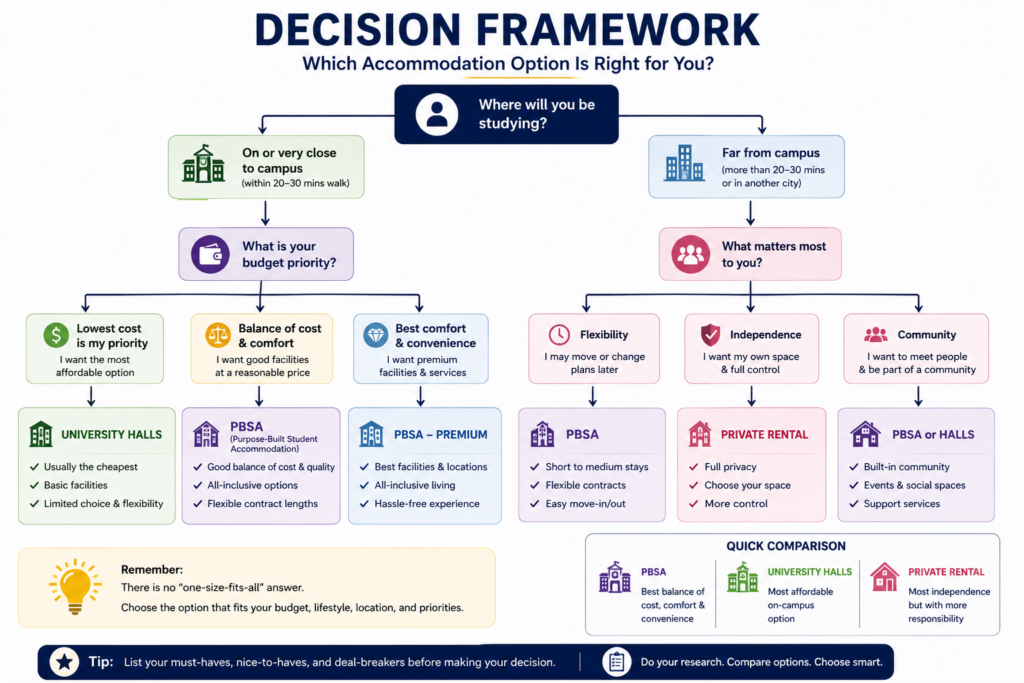
Ask yourself these five questions, in order.
1. Do I have a guarantor in my destination country? No: lean toward PBSA or university halls. Yes: private renting becomes realistic.
2. Is this my first year in a new city? Yes: PBSA reduces the number of unknowns you’re managing at once. No, and I already know the city and have contacts: private renting shared with friends can save money.
3. Can I visit the property in person before signing? No, I’m booking from Nigeria: stick to verified PBSA operators or university-approved platforms to avoid scams. Yes, I’ll be there to view it: private renting is safer to pursue.
4. How important is bill predictability to my monthly budget? Very important, I’m managing a fixed remittance from home: PBSA’s all-inclusive rent removes a major source of budget shock. I have some flexibility: separate private-rental bills are manageable.
5. Am I planning to stay in this city beyond one academic year? Yes: consider a 12-month private lease to avoid a summer accommodation gap. No, or unsure: PBSA’s academic-year contract matches your timeline exactly.
Common Misconceptions About PBSA
“PBSA is always more expensive than private renting.” Not necessarily. It’s often more expensive than a shared private house split many ways, but frequently cheaper than a solo private studio once bills and deposits are included.
“PBSA is only for first-year students.” Many students stay in PBSA for their entire degree, particularly international students who value the predictability and don’t want to manage a private landlord relationship from abroad.
“All PBSA buildings are the same standard.” They’re not. Quality, room size and included amenities vary widely between operators and buildings, even in the same city. Read reviews and, where possible, ask for a virtual tour before booking.
“You need a guarantor for PBSA too.” Most PBSA operators serving international students have streamlined processes that don’t require a local guarantor, often accepting an upfront payment or an international guarantor service instead. Confirm this with the specific operator, since policies differ.
2026 Trends Worth Knowing
The UK PBSA sector now houses over 700,000 students in purpose-built beds, and demand still outpaces supply in several major university cities, which keeps prices firm rather than falling. In Canada, the PBSA market remains one of the most undersupplied globally relative to international student numbers, meaning early booking matters more than ever if you want a PBSA option rather than being pushed toward private renting by default. In the USA, PBSA penetration is still low compared to the UK, but investment in the sector grew sharply through 2025 and into 2026, particularly around universities with strong international enrollment, which should gradually widen your PBSA options in more US cities over the next few years.
Pros and Cons of PBSA
| Pros | Cons |
|---|---|
| All-inclusive rent, easier budgeting | Often pricier than a shared private house |
| No guarantor needed in most cases | Less control over roommates in cluster flats |
| Fully furnished, ready to move in | Fixed academic-year contract may not match your program length |
| On-site security and staff | Building quality varies by operator |
| Easier and safer to book from abroad | Limited room to negotiate rent |
| Close to campus or city centre | Popular buildings fill up months in advance |
A Checklist Before You Book PBSA From Nigeria
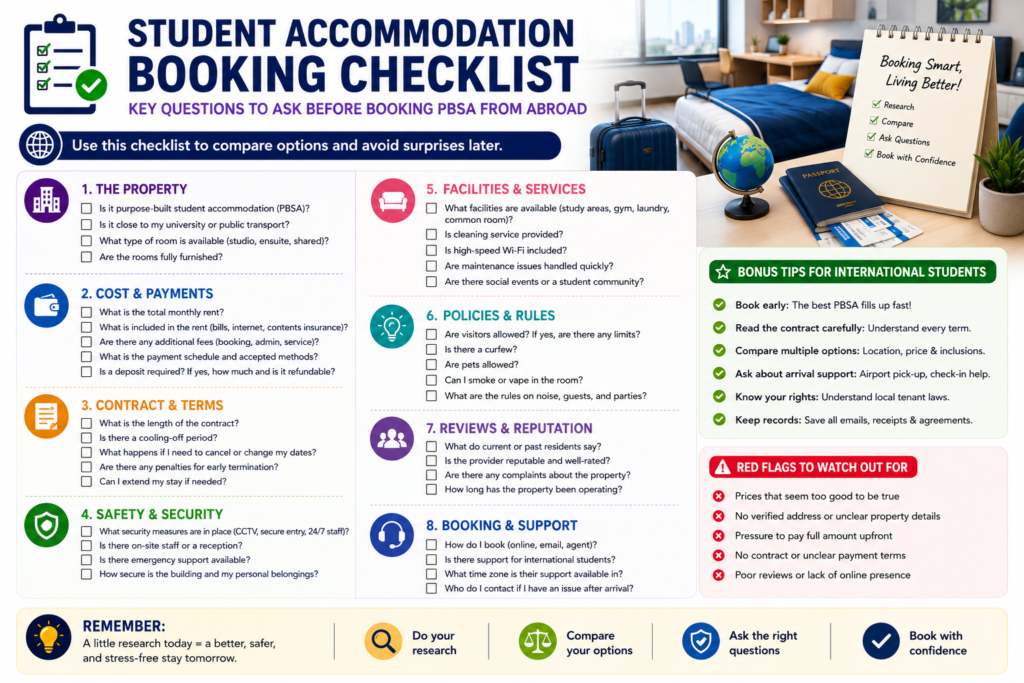
- Confirm the operator is a real, verifiable company with a physical address and reviews from current or past tenants
- Ask exactly what’s included in the rent: electricity, water, heating, internet, contents insurance
- Confirm the contract length and whether it covers the full period you’ll need housing
- Ask about the cancellation and refund policy in case your visa is delayed or refused
- Request a virtual tour or recent photos of the specific room, not just marketing images
- Check the distance and commute time to your actual campus, not just “near university” in the listing
- Clarify the deposit amount and how it’s protected
- Confirm whether the price you’re shown includes VAT, service charges or a booking fee
- Ask whether the building offers short lets if your program starts or ends outside standard academic dates
Wrapping Up
PBSA isn’t automatically the cheapest option, and it isn’t automatically the most expensive either. What it consistently offers is predictability: one monthly payment, a furnished room waiting for you, and a booking process you can complete safely from Lagos, Abuja or Port Harcourt without a guarantor or a site visit. For many Nigerian students in their first year abroad, that predictability is worth more than a modest saving from a shared private house you’d have to view, furnish and manage bills for on your own.
Before you book anything, compare at least three options in your specific city, using the framework above, and confirm every number directly with the provider or your university’s accommodation office. Rents move quickly in undersupplied markets, and the figure you saw online in January may not hold by August.
9. COMPARISON TABLES SUMMARY
(Full tables are embedded in the article above: UK monthly rent by type and city, Canada monthly rent by city, USA monthly rent by market, PBSA vs Halls vs Private Rental feature comparison, and Pros vs Cons of PBSA.)
10. FAQs (People Also Ask)
1. What does PBSA stand for? PBSA stands for purpose-built student accommodation. It refers to housing that’s designed and constructed specifically to house students, rather than an ordinary house or flat that’s been adapted for student tenants. PBSA buildings are typically owned and operated by private companies, sometimes in partnership with universities, and include amenities like study rooms, security staff and all-inclusive rent.
2. Is PBSA cheaper than renting privately? It depends on what you’re comparing. PBSA is usually more expensive than a private house shared with several roommates, but often cheaper than renting a private studio alone once you add utility bills, deposits, furniture and guarantor requirements to the private rental’s base price. Compare the full cost, not just the headline rent.
3. Do international students need a guarantor for PBSA? Most PBSA operators serving international students don’t require a local guarantor. Many accept an upfront payment, an international guarantor service, or a larger deposit instead. Requirements vary by operator, so confirm directly before booking.
4. What’s included in PBSA rent? Most PBSA rent is all-inclusive, covering electricity, heating, water and high-speed internet. Many buildings also include access to a gym, study rooms and communal social spaces. Always check the specific inclusions for your building, since policies vary between operators.
5. How far in advance should I book PBSA? Book four to six months before your program starts, particularly in high-demand cities like London, Toronto or Boston, where popular PBSA buildings fill up well before the academic year begins. Undersupplied markets like Canada reward early booking even more than the UK or USA.
6. Can I cancel my PBSA booking if my visa is refused? Most PBSA operators have a visa refusal clause that allows a refund if you provide proof of refusal, but the terms differ by provider. Read the cancellation policy carefully before you pay a deposit, and ask directly if it isn’t clearly stated in the contract.
7. Is PBSA safer than private renting for international students? PBSA reduces certain risks, particularly rental scams, since bookings go through a verifiable operator rather than an individual landlord you can’t meet in person. PBSA buildings also typically include on-site security and staff, which most private rentals don’t offer.
8. What’s the difference between PBSA and university halls? University halls are owned and run directly by the university. PBSA is owned and run by private companies, sometimes in partnership with a university. Both are built specifically for students, but PBSA buildings are often newer, may offer more premium amenities, and typically cost more than standard halls.
9. Do PBSA contracts run for a full year? Most PBSA contracts run for 44 to 51 weeks, matching the academic calendar, though some operators now offer 12-month contracts. Check the exact contract length against your program dates before booking, especially if your course starts or ends outside the standard academic year.
10. Which is better for first-year international students, PBSA or private renting? PBSA is generally the more practical choice for a first year abroad, particularly if you’re booking from Nigeria without the chance to view properties in person. It removes the guarantor barrier, comes furnished, and offers a predictable monthly cost while you’re still learning your way around a new city.
11. Does PBSA cost the same across the UK, Canada and the USA? No. UK PBSA is the most established and widely available, with prices ranging roughly from £700 to over £2,000 a month depending on the city and room type. Canadian PBSA tends to run higher relative to private rentals due to undersupply. US PBSA sits closer to the national average of around $900 to $950 per bed per month, similar to a shared off-campus apartment once bills are included.
12. Can I negotiate PBSA rent? Room for negotiation is limited compared to private renting, since PBSA operators set fixed pricing tiers by room type. That said, some operators offer discounts for early booking, longer contracts, or referral schemes. It’s worth asking directly, particularly outside peak booking season.
