
hybrid study abroad, study abroad programs, online and overseas degree programs, blended study abroad programs, international hybrid education, flexible study abroad programs, affordable study abroad programs, low-cost study abroad options, hybrid international degree,
Hybrid Study Abroad Programs: How to Study Part-Online, Part-Overseas in the USA and Cut Your Costs
You want a US degree, but the full package, four years on campus, a visa from day one, and $40,000 a year, feels out of reach. That gap is why hybrid study abroad programs exist. They let you start your coursework online from Lagos, Nairobi, Accra, or wherever you are, then move to a US campus once you have money, credits, and a stronger visa file in place.
This guide covers how hybrid programs actually work in the US system, what they cost in 2026, how the F-1 student visa treats online coursework, and how to tell a legitimate hybrid pathway from a program that will leave you stuck. By the end, you will know the specific questions to ask a university before you pay a single naira or dollar toward one of these programs.
What a Hybrid Study Abroad Program Actually Is
| Definition: A hybrid study abroad program combines online coursework, usually completed in your home country, with a required period of in-person study on a US campus. You earn one degree, issued by one institution, but you do not have to relocate for the entire program. |
This is different from two things people often confuse it with. A fully online degree never requires you to set foot on campus, and it will not support an F-1 student visa on its own. A traditional study abroad program puts you on a plane before you have taken a single class. Hybrid sits between the two: some of your credits are earned remotely, and the rest are earned in person, under an F-1 visa, once you transition to campus.
In practice, hybrid pathways to the US take a few different shapes, and the shape matters more than the marketing term a school uses.
RECOMMENDED POST:
Purpose-Built Student Accommodation (PBSA): What It Is and Why It Can Cost Less Than Private Rentals Abroad
1. Low-Residency Degree Programs
Some US universities run low-residency hybrid degrees, mostly at the graduate level, where you complete the bulk of coursework online and travel to campus only for short residencies each term. New Mexico State University’s Global Campus, for example, runs low-residency hybrid master’s programs built specifically for international students who plan to hold an F-1 visa but do not want to relocate for the entire program length.
2. University Partnership or Pathway Programs
A partner institution in your home country or region teaches the first stage of a program, often the first year of an undergraduate degree, and the credits transfer directly into a partner US university. You finish the degree on the US campus. Shorelight is one organization that runs this model with a number of US partner schools, and it is worth checking directly with any school’s international admissions office whether they run something similar.
3. Gap-Semester and Delayed-Start Models
A newer version of hybrid enrollment has US universities admitting students fully, then structuring a first semester that happens away from the main campus, sometimes abroad through a program partner, sometimes through independent study, before the student joins the regular class in a later term. NYU’s spring-start option and partnerships some universities run with programs like Verto Education fall into this category. These are not built primarily as cost-saving tools, but they do delay the point at which you need a full year of on-campus funding lined up.
4. Blended Master’s and Executive Programs
Business, healthcare administration, and technology master’s programs are the most common places to find hybrid formats, since working professionals are a large part of the applicant pool and full relocation is often not realistic for them. Belhaven University’s international graduate programs, which combine online coursework with scheduled on-campus residencies, are one example of this format built specifically for F-1 visa holders.
Why This Model Is Gaining Ground Among Nigerian and African Students
A traditional US study abroad plan asks you to solve every problem at once: full tuition, a full year of living costs, a visa interview, and a relocation, all before your first class starts. That is a hard combination for most families to fund in one go, and it is a major reason visa officers cite when refusing F-1 applications, insufficient evidence that the full cost is already covered.
Hybrid programs break that into stages. You can:
- Spread tuition and living costs over a longer period instead of paying a full year up front.
- Build a track record of paid, verifiable coursework before you sit a visa interview, which strengthens your case that you are a genuine student rather than someone using education as a cover for other plans.
- Keep a job or family responsibilities going while you study, then transition once your finances and paperwork are ready.
- Test whether a program and institution are a good fit before committing to relocation.
None of this makes hybrid programs a shortcut around visa requirements or cost. It changes the order in which you face those requirements, not whether you face them.
The Real Cost of a Hybrid US Program in 2026
Costs vary widely by institution, program level, and city, so treat the figures below as planning ranges, not quotes. Always confirm exact numbers on the school’s own cost of attendance page before you commit.
| Cost Item | Typical Range (2026) | Notes |
| Tuition (per year) | $20,000 – $45,000 | Public universities and low-residency hybrid programs tend to sit at the lower end; private and specialized master’s programs sit higher. |
| Living costs, smaller US city | $1,200 – $1,800 / month | Covers rent, utilities, food, and daily expenses in lower cost-of-living areas. |
| Living costs, major city | $3,000+ / month | New York, San Francisco, and similar cities cost significantly more. |
| I-901 SEVIS fee | $350 | One-time fee, paid once per SEVIS record, before your visa interview. |
| DS-160 visa application (MRV) fee | $185 | Paid to the US Department of State, non-refundable, required before scheduling your interview. |
| School/document processing fees | Varies by school | Some schools charge separate fees for I-20 issuance or orientation. |
How the F-1 Visa Treats Hybrid and Online Coursework
This is the part most students get wrong, and it is worth being precise about. The F-1 visa is built around full-time, in-person study. US immigration rules allow an F-1 student to count no more than one class, or three credit hours, of online coursework per term toward a full course of study while they are physically present in the United States.
That rule applies once you are already in the US on your visa. It does not stop a hybrid program from working, because the online portion of a hybrid pathway typically happens before you travel, while you are still in Nigeria, Ghana, Kenya, or wherever you are based, and before your F-1 status has started. Your school’s international student office, usually run by a Designated School Official, or DSO, will tell you exactly which of your specific program’s credits count toward your F-1 status once you are on campus.
Two points matter here. First, a program that is entirely online, with no scheduled in-person component, will not support an F-1 visa at all, because it is not what SEVP-approved schools consider a full course of study. Second, once you arrive in the US on an F-1 visa, your school must confirm to SEVIS that your enrollment plan follows the one-class online limit for as long as you are physically present. Ask the DSO to walk you through this before you apply, not after you have paid a deposit.
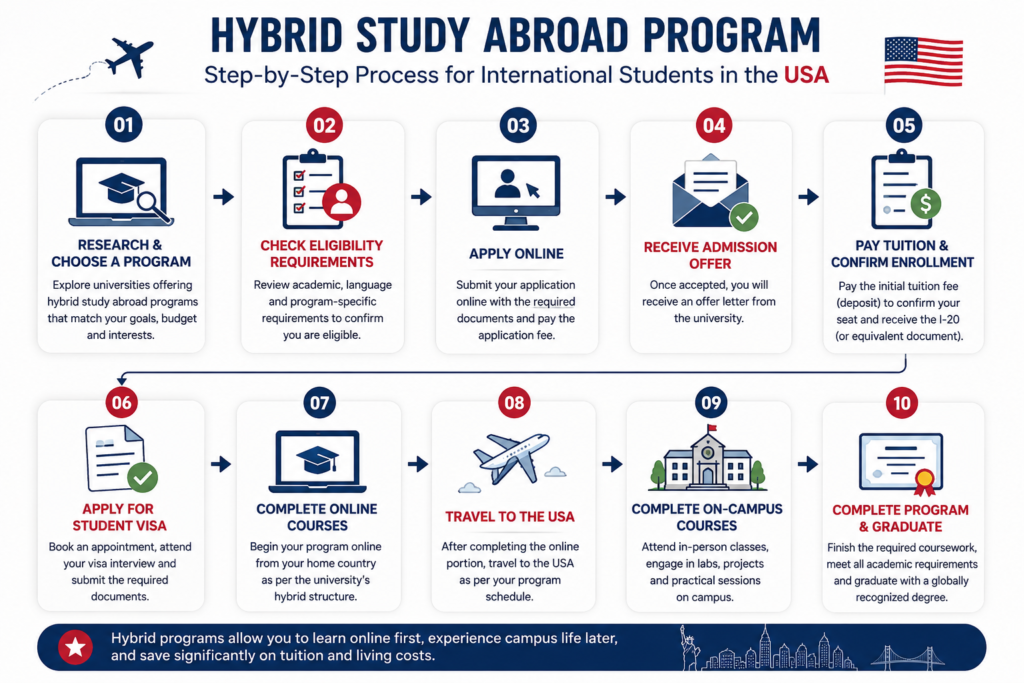
Step-by-Step: How a Hybrid Pathway to the US Usually Works
- Research schools that run a genuine hybrid or low-residency track, and confirm directly with their international admissions office that the program is SEVP-approved and structured to support an F-1 visa.
- Apply and get admitted, then request a breakdown of which terms or courses are completed online versus on campus.
- Complete the online phase from home. Keep every receipt, transcript, and payment record; you will need these later as evidence of continuous, genuine study.
- Once you are ready to transition to campus, your DSO issues Form I-20, the certificate you need to apply for an F-1 visa.
- Pay the SEVIS I-901 fee at fmjfee.com and the DS-160 visa application fee, then complete the DS-160 form online.
- Book and attend your visa interview at the nearest US embassy or consulate, bringing your I-20, fee receipts, admission letter, academic records, and financial evidence.
- Travel to the US no earlier than 30 days before your program start date and begin the on-campus phase of your degree.
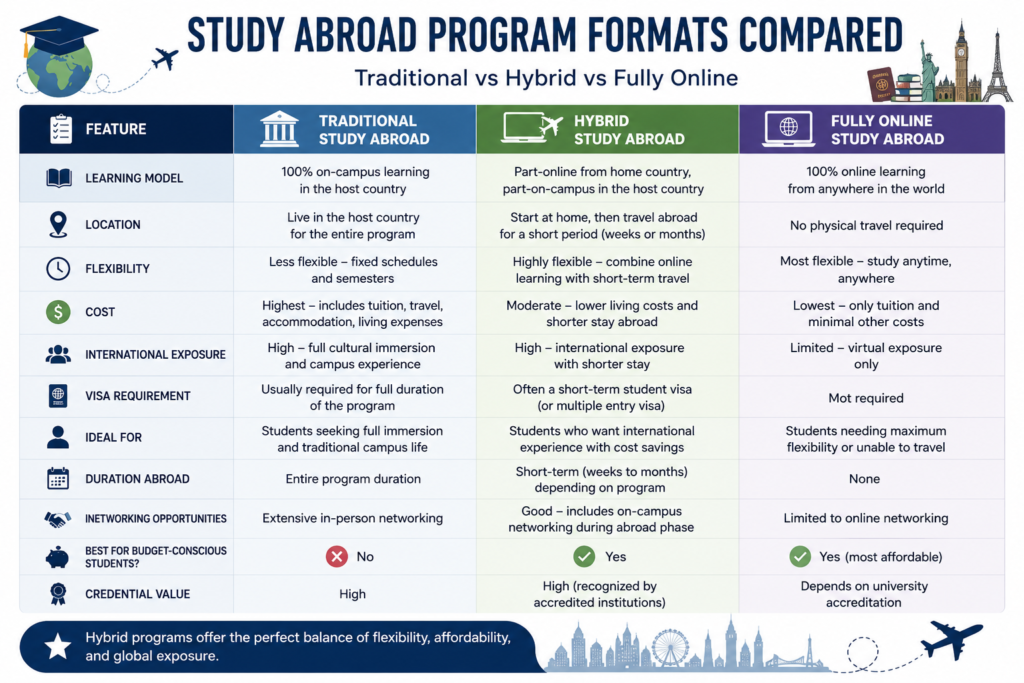
Hybrid vs Online vs Traditional Study Abroad: A Side-by-Side Comparison
| Factor | Traditional Study Abroad | Hybrid Study Abroad | Fully Online Degree |
| Relocation required | Immediate, before classes start | Delayed, after online phase | Never |
| Supports F-1 visa | Yes | Yes, once on-campus phase begins | No |
| Upfront cost pressure | Very high | Moderate, spread over time | Low |
| Cultural immersion | Full, from day one | Partial, begins later | None |
| Visa interview strength | Must show full-year funding immediately | Can show a study record plus staged funding | Not applicable |
| Best for | Students fully funded and ready to relocate now | Students building funds or credentials in stages | Students who do not need a US-based credential |
Pros and Cons of Hybrid Study Abroad Programs
Advantages
- Lower upfront financial pressure since costs are staged rather than paid in one lump sum.
- More time to prepare a strong visa application with real study history behind it.
- A chance to confirm the program and school are the right fit before you relocate.
- Flexibility to keep earning income or managing family responsibilities during the online phase.
Disadvantages
- Delayed access to campus resources, in-person networking, and internship opportunities tied to being physically present.
- Time zone differences can make live online sessions difficult during Nigerian or wider African working hours.
- Not every ‘hybrid’ program is F-1 compatible; some are marketing terms for programs that will not support a visa at all.
- You still face the full visa and funding requirements eventually; hybrid only changes the timing, not the total cost.
Common Misconceptions About Hybrid Study Abroad
“Hybrid means cheaper tuition.”
Not necessarily. Hybrid changes when you pay, not always how much. Some low-residency programs are priced lower because they reduce on-campus housing and facility use, but this is program-specific, not a rule.
“I can do the whole degree online and just visit for graduation.”
No. If a program has no required in-person component, it cannot support an F-1 visa, and calling it ‘hybrid’ in marketing material does not change that fact under US immigration rules.
“Starting online guarantees my visa will be approved later.”
It does not. A visa officer will still assess your funding, ties to your home country, and academic intent at the time of your interview. A hybrid study history can help your case, but it is not a guarantee.
2026 Trends Shaping Hybrid Study Abroad
- More US universities are formalizing low-residency hybrid master’s programs specifically to attract international applicants who cannot relocate immediately.
- Selective universities are expanding delayed-start and partner-abroad admission tracks partly to manage limited campus capacity, which is opening more structured pathways for admitted students.
- Universities are being more explicit in their marketing about F-1 visa compatibility, a direct response to past confusion between hybrid and fully online offerings.
- Interview patterns in 2026 show consular officers spending less time per interview and focusing more sharply on funding proof and home-country ties, which makes a staged, well-documented hybrid study history more useful than it used to be.
A Practical Checklist Before You Apply
- Confirm the school is SEVP-certified and can issue Form I-20.
- Get written confirmation of exactly which courses or terms are online and which are on campus.
- Ask what percentage of the program must be completed in person under US immigration rules.
- Request the full cost of attendance, including tuition, fees, and estimated living costs for the specific city.
- Check whether the online phase uses live sessions and confirm the time zone commitment against African working hours.
- Ask about credit transfer policies if you need to change programs or schools later.
- Speak with current or former students from your country if the school can connect you with any.
- Verify visa and SEVIS fee amounts directly on fmjfee.com and travel.state.gov before budgeting, since government fees can change.
Where to Get Reliable Guidance
EducationUSA, a US Department of State network with advising centers across Nigeria and other African countries, offers free, official guidance on US university admissions and visa processes. Use it alongside, not instead of, direct conversations with each school’s international admissions office, since program structures differ by institution.
Next Steps
Hybrid study abroad will not remove the cost or the visa requirements of a US degree. What it does is let you meet those requirements in stages instead of all at once, which is often the difference between a plan that stays on paper and one you actually complete. Start by shortlisting two or three schools with a genuine, F-1-compatible hybrid track, then get their cost of attendance and visa compatibility confirmed in writing before you apply.
Frequently Asked Questions
Can I do a full US degree online and never travel?
You can earn a US degree through a fully online program, but it will not support an F-1 student visa, and if living in the US is part of your goal, a fully online degree does not get you there. Hybrid programs are built specifically to combine online study with a required in-person phase so they can support a visa.
How much of a hybrid program has to be completed on campus?
This depends on the specific school and program. Once you are physically present in the US on an F-1 visa, immigration rules cap online coursework at one class or three credit hours per term. Your school’s international student office can tell you exactly how your program’s terms are structured before you apply.
Is a hybrid degree from a US university viewed the same as a fully on-campus degree?
Yes, in almost all cases. You receive the same degree as a student who studied entirely on campus, from the same accredited institution. Employers and other universities generally do not distinguish between the two on a transcript or diploma.
Does starting a program online improve my chances of getting an F-1 visa later?
It can strengthen your file by showing a documented academic history and giving you more time to build savings and evidence of ties to your home country. It does not guarantee approval. Consular officers still evaluate funding, academic intent, and home-country ties at the time of your interview.
What is the SEVIS fee and when do I pay it?
The I-901 SEVIS fee is $350 for F-1 students as of 2026, paid once per SEVIS record through fmjfee.com after you receive your Form I-20 and before your visa interview. It is separate from the $185 DS-160 visa application fee. Confirm current amounts directly on fmjfee.com, since fees can change.
Can I work while studying in the online phase of a hybrid program?
While you are outside the US and not yet on an F-1 visa, US work authorization rules do not apply to you, so local employment in your home country is a separate matter governed by your own country’s laws. Once you are in the US on F-1 status, on-campus and off-campus work are restricted and require specific authorizations such as CPT or OPT.
Are hybrid study abroad programs legitimate, or are they a visa workaround?
Legitimate hybrid programs are run by accredited, SEVP-certified US institutions and are fully compliant with immigration rules. Be cautious of any agency or program that markets a way to ‘guarantee’ a visa or claims a fully online course will lead to US residency; that is not how the F-1 system works, and such claims are a red flag.
How do I know if a specific university’s hybrid program is F-1 compatible?
Ask the school’s international admissions or international student office directly whether the program is SEVP-approved and whether it issues Form I-20 for the on-campus phase. Get this confirmation in writing before you pay any fees.
What happens if I can’t afford the on-campus phase after finishing the online portion?
Talk to the school’s international student office as early as possible. Some institutions offer deferred enrollment, payment plans, or the option to pause and resume within a set timeframe. Policies vary widely, so confirm this before you enroll rather than after you are partway through the program.
Do hybrid programs qualify for Optional Practical Training (OPT) after graduation?
Generally yes, since OPT eligibility is tied to completing a full course of study on F-1 status at a SEVP-certified school, not to whether some earlier coursework was completed online before your visa began. Confirm this with your DSO based on your specific program structure.
Author Notes
Fact-check reminders: Tuition and living cost ranges are drawn from published 2026 estimates and vary by institution and city; confirm exact figures on each school’s cost of attendance page before publishing final numbers to readers. SEVIS ($350) and DS-160 ($185) fees are current as of mid-2026 per official ICE and Travel.State.Gov sources but are subject to change; link directly to fmjfee.com and travel.state.gov rather than restating fees as permanent. Program examples (NMSU Global Campus, Belhaven University, Shorelight partner network, NYU spring start, Verto Education partnerships) are cited as illustrations of program types, not endorsements; verify each school’s current F-1 compatibility directly before recommending it by name. Recommend a review of this article every two to three months given how frequently visa fees and program structures change.
